Karakuri IoT: paper tokens for factory ideas
I was asked to build a sensor kit that factory workers could use without programming. I ended up building something made mostly of paper, and it started my PhD.
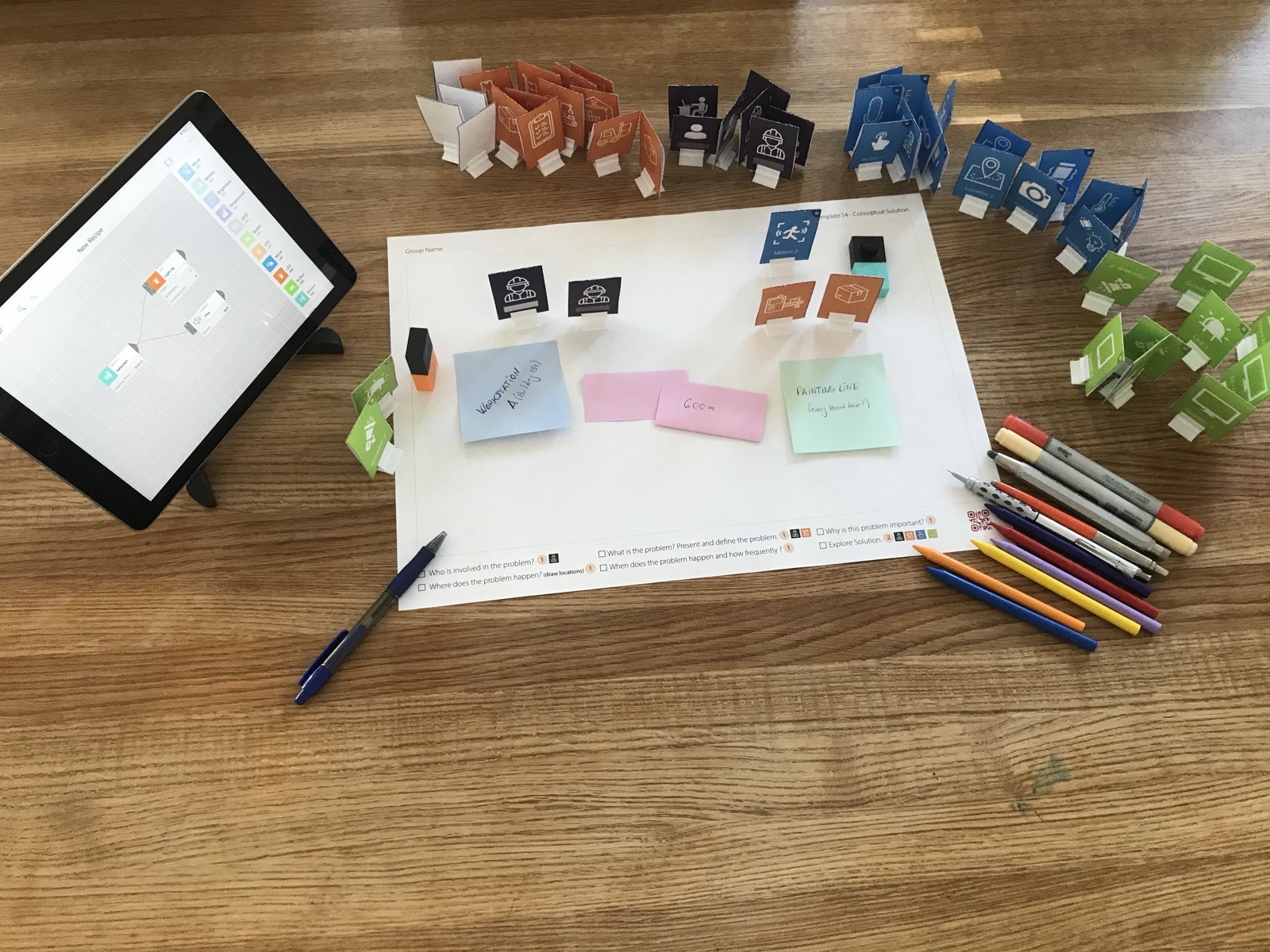
Karakuri, with sensors
In Japanese factories there is a movement called Karakuri Kaizen. Workers build small devices that automate simple tasks, like moving a box from one point to another, with cheap materials and natural forces such as gravity and magnets. No engineers are needed. The devices are shown at a yearly exhibition, held since 1993.
The Karakuri IoT project started with this question: what if the same spirit worked with the Internet of Things? Could people on the shop floor improve their own work with simple, low-cost sensors, without knowing programming or electronics?
I joined in 2017, during the pre-study, as the interaction designer. My task was to build that sensor kit. It soon became clear that a kit with those qualities would take months, if not years. The pre-study had a few weeks. So I had to find something simpler that workers could use to think with IoT right away.
First, stickers
Before designing anything, I looked at what workers actually wanted. In early workshops, people had sketched eighty improvement ideas as storyboards with sticky notes: an operator who finds out too late that the packaging material has run out; another who walks around looking for testing equipment and can’t find it.
With those eighty ideas next to me, I listed the sensors sold in electronics shops and the themes of Industry 4.0, and kept only what was cheap and simple. Then I turned the list into a sheet of stickers. In groups of three or four, workers discussed a problem, picked stickers, and glued them on an A3 paper when they agreed on a solution.
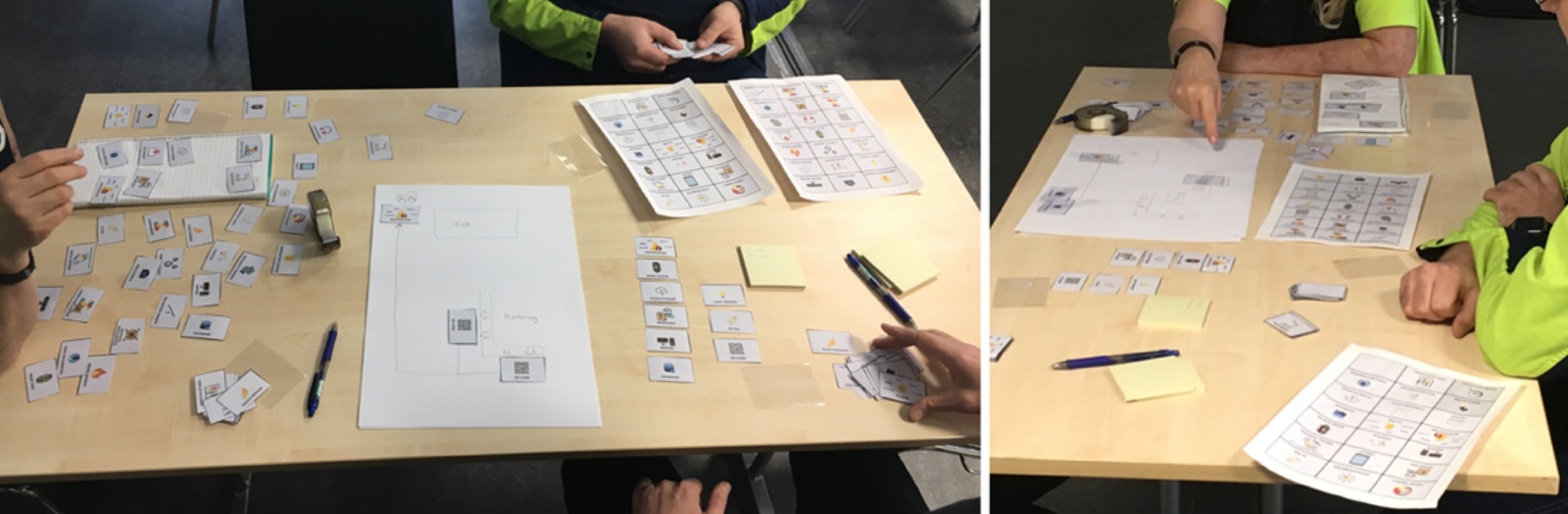
It worked better than we expected. Participants and their managers gave us good feedback, and it made the team see the materials as something more than a stand-in for the missing kit. It also made me curious enough to start a PhD about it.
Then, cards
The pilot also showed the problems: stickers were hard to find in the pile, and people didn’t always know what a sensor did. So I redesigned them as a deck of 27 cards, in four colours: sense (blue) for sensors, notify (orange) for ways of telling people something, analyse (maroon) for storing data and finding trends, and five green joker cards for anything the deck didn’t cover. Each card had a title, an icon and a short description. The backs were magnetic, so they also worked on a whiteboard.
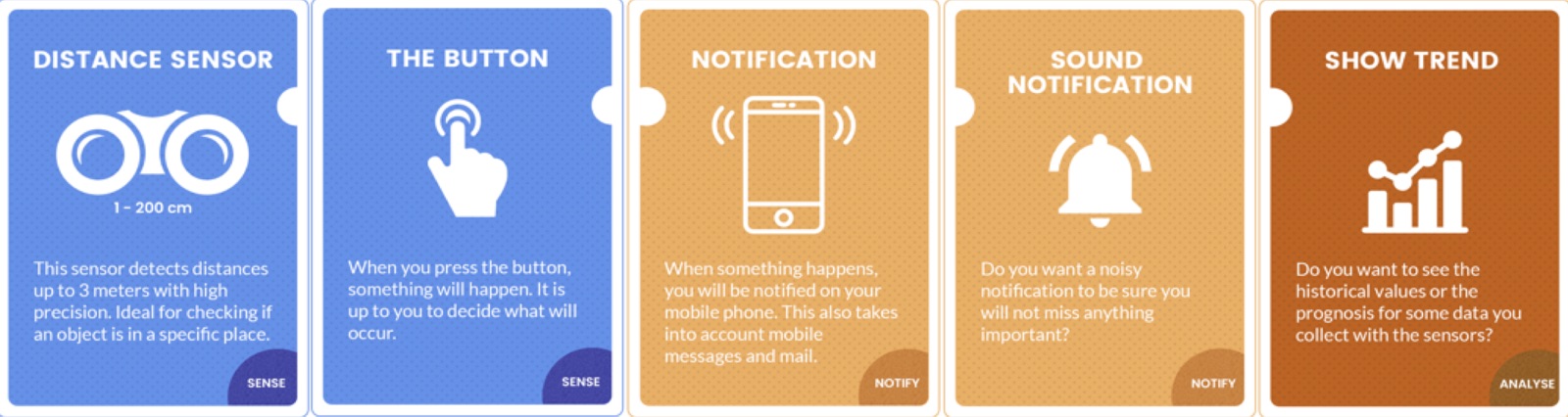
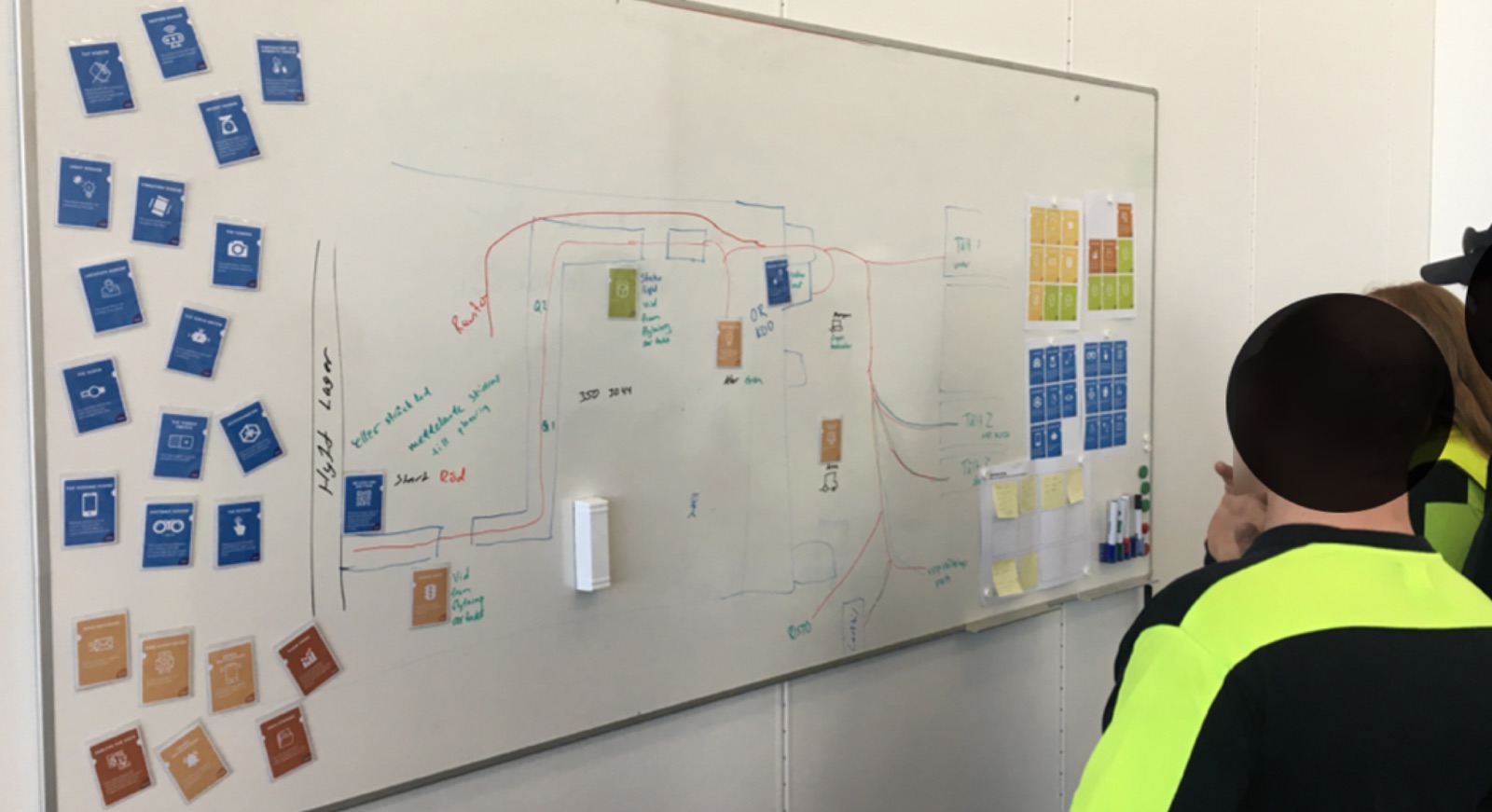
I tested the cards in three workshops in factories. Groups drew the factory, placed the cards on it, and connected them with lines and arrows. While they talked, they kept pointing with their fingers: here is where she works, this is who needs to know, this is where the trolley goes.
What the diagrams left out
When I went back to the diagrams, I noticed that much of what made the conversations good was missing on paper. In one idea, an operator had to know when to bring new material and when to collect empty baskets. The drawing showed the places and the sensors, but not the people. Who sees the lamp change colour? Who switches off the alarm? Where is everyone?
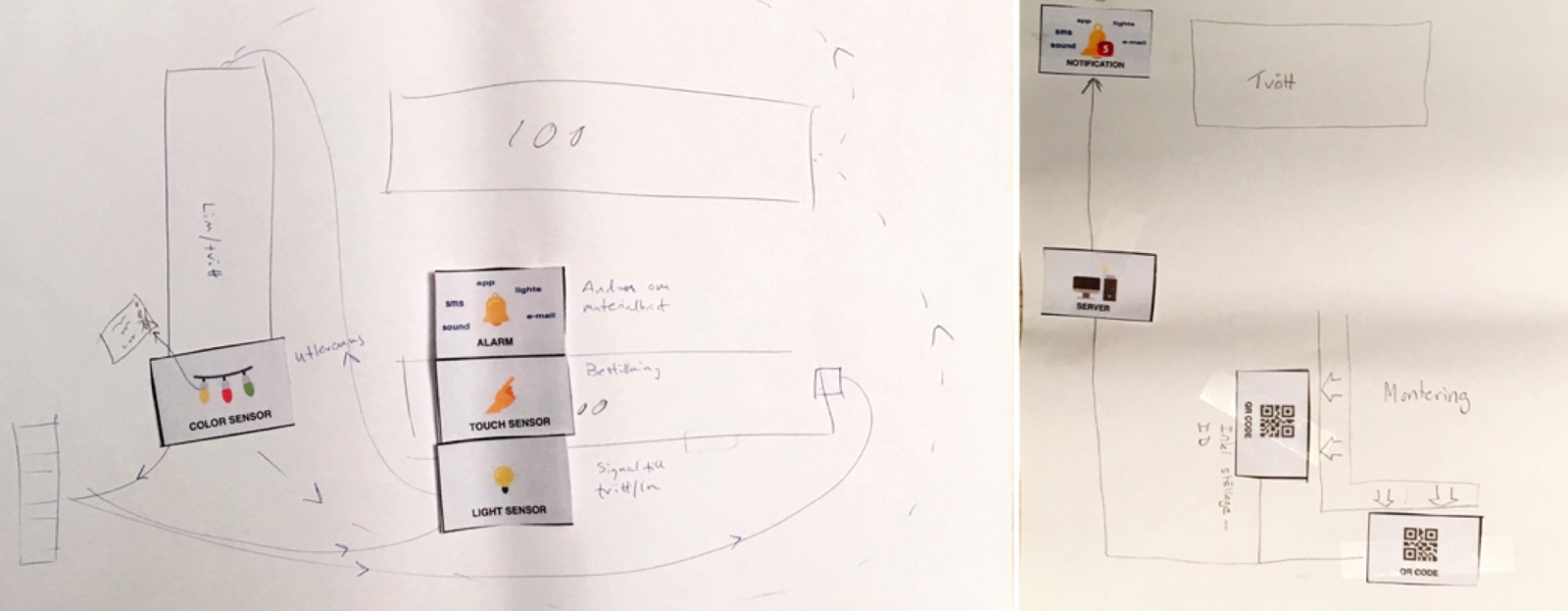
Three things were missing:
- People. With more than one person in a solution, it was hard to follow who was where.
- Things. Forklifts, boxes, machines and shelves came up all the time, but they were rarely drawn.
- Time. Arrows tried to show movement and order, but a drawing is a snapshot. It can’t show what happens first and what happens next.
This changed how I saw IoT. I had come to it from product design, where a smart object is a thing with a computer inside. Now I saw it as relations: people, technology, places and the work people do there. The materials had to help people make those relations visible.
And there was one more need. These are work ideas. If they are good, someone will have to build them, so the results have to be documented well enough to send to IT, to other departments, or to a consultant.
Finally, tokens
Around that time, the project leader found a small commercial sensor kit made for children (MESH). It hid the electronics and the code: you set simple “if this, then that” rules in an app on a tablet. That took the pressure off building our own kit, and let me focus on the paper side.
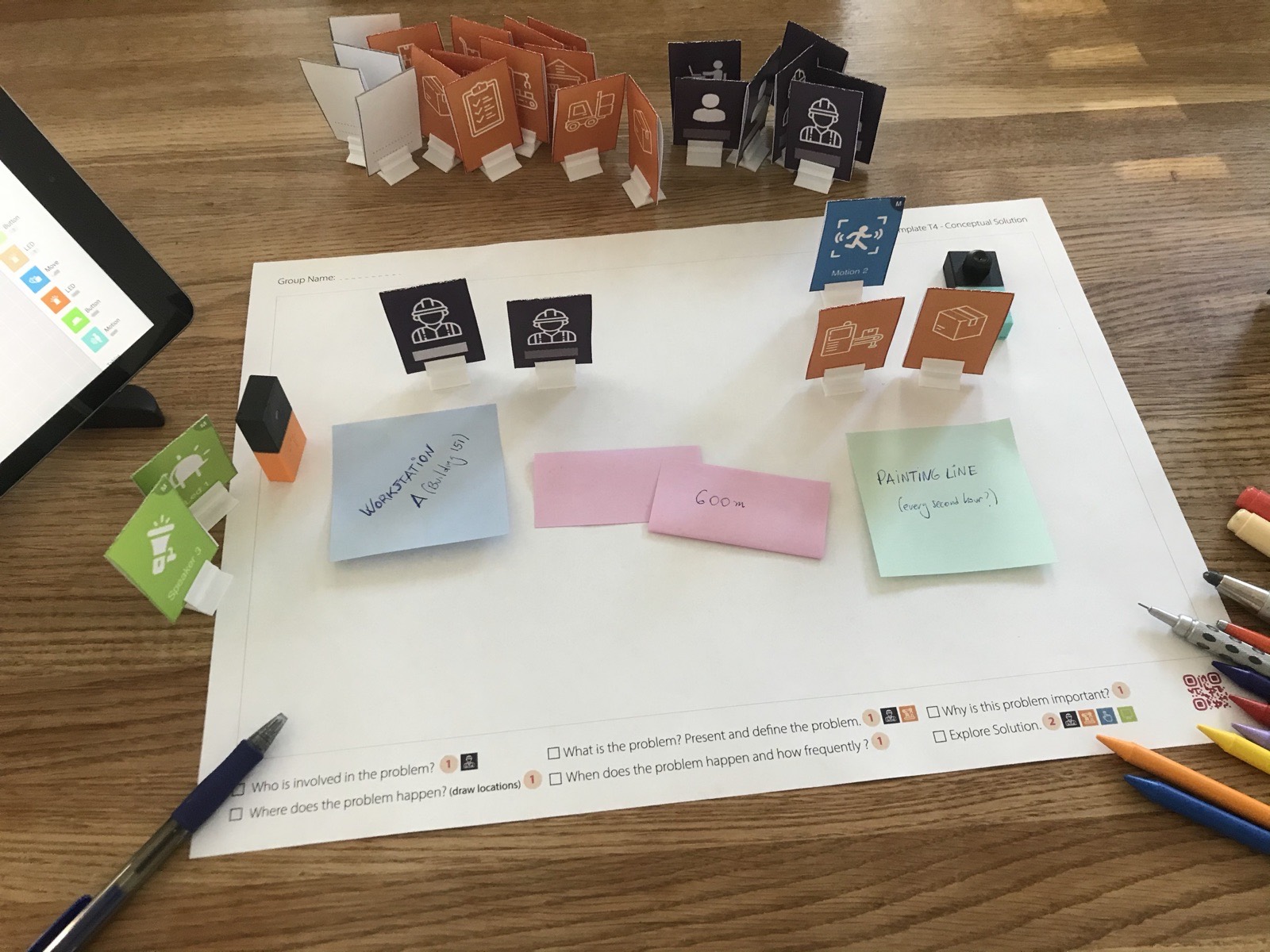
I took the idea of business origami, a way of modelling services with paper figures, and turned the cards into tokens that stand up on their own. The toolkit has five colours:
- People, in dark purple, eight tokens with no names, so they can be anyone.
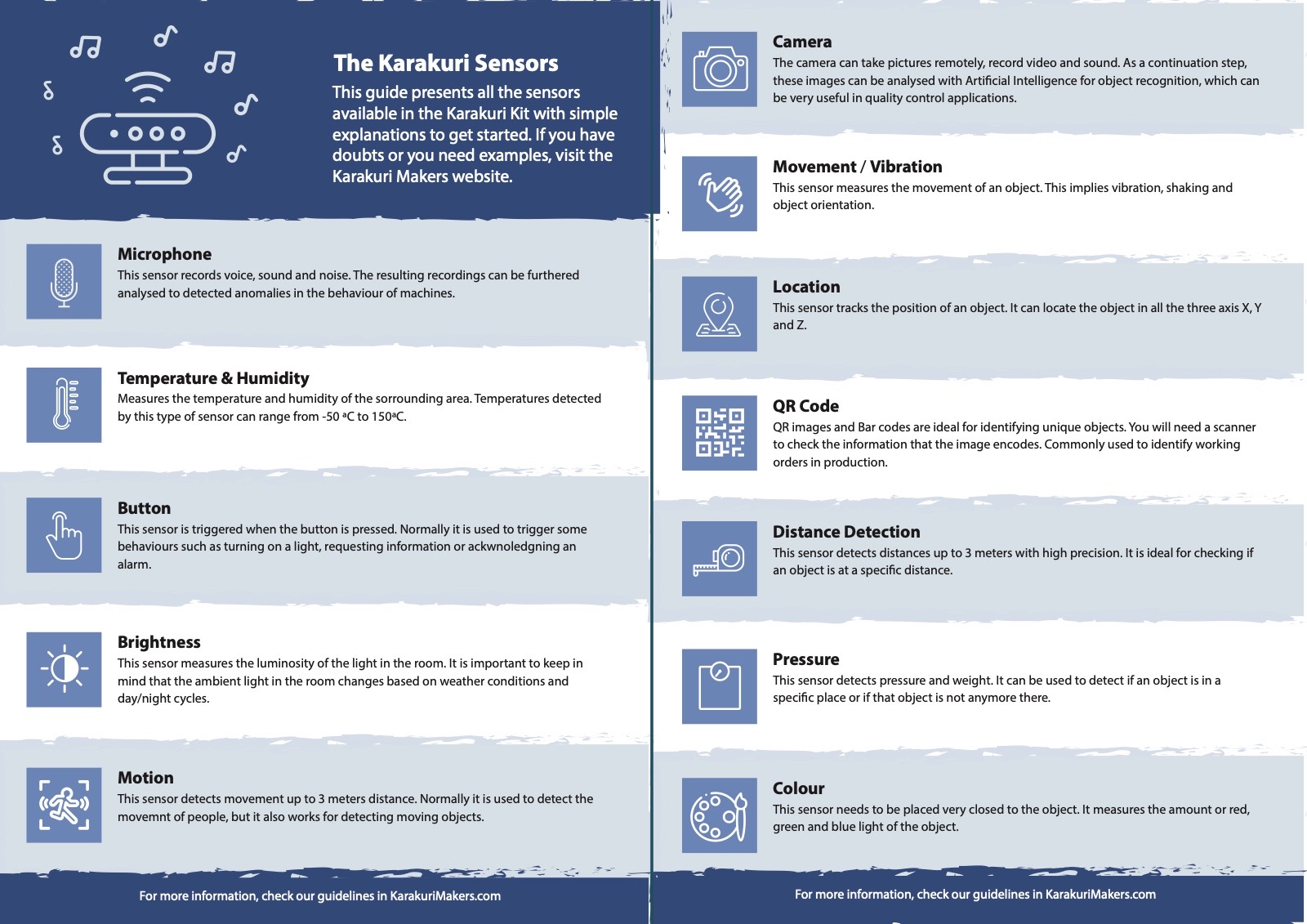
- Sensors, in blue: button, brightness, microphone, temperature, motion, camera, distance, colour, QR code, pressure and more.
- Notifications, in green: speaker, phone, tablet, LED, smartwatch, screen, scoreboard.
- Industrial elements, in orange: boxes, shelves, forklifts, trucks, machines, robots, conveyor belts. They have no labels either, so one token can be whatever the story needs.
- Blank tokens, to copy one that runs out or invent a new one.
Around them: a canvas that works as a stage, instructions for each activity with times and examples, QR codes to short videos, a guide to what each sensor does, and six real sensors.
The canvas carries the questions of a good scenario: who is involved, where it happens, what the problem is, when and how often, and why it matters. Each question has small icons that tell you which tokens you need for it.
Six steps
The tokens came with a method, in six steps:
- Introduction to Karakuri IoT and its materials.
- Demystifying IoT. Small challenges with the real sensors, to learn what they can and can’t do, including what happens when they trigger by accident.
- Brainstorming ideas for improvements.
- Factory tour to the places in the ideas, so everyone in the group knows them.
- A conceptual solution, role-played with the tokens and recorded on video.
- A proof of concept, where the paper sensors are swapped for real ones, and the scenario is role-played and recorded again.
Two steps are what make it different from a general design-thinking model: the demystifying step, so people know what IoT can do before they imagine with it, and the factory tour. The videos run through steps three, five and six, so documentation is part of the method, not an afterthought.
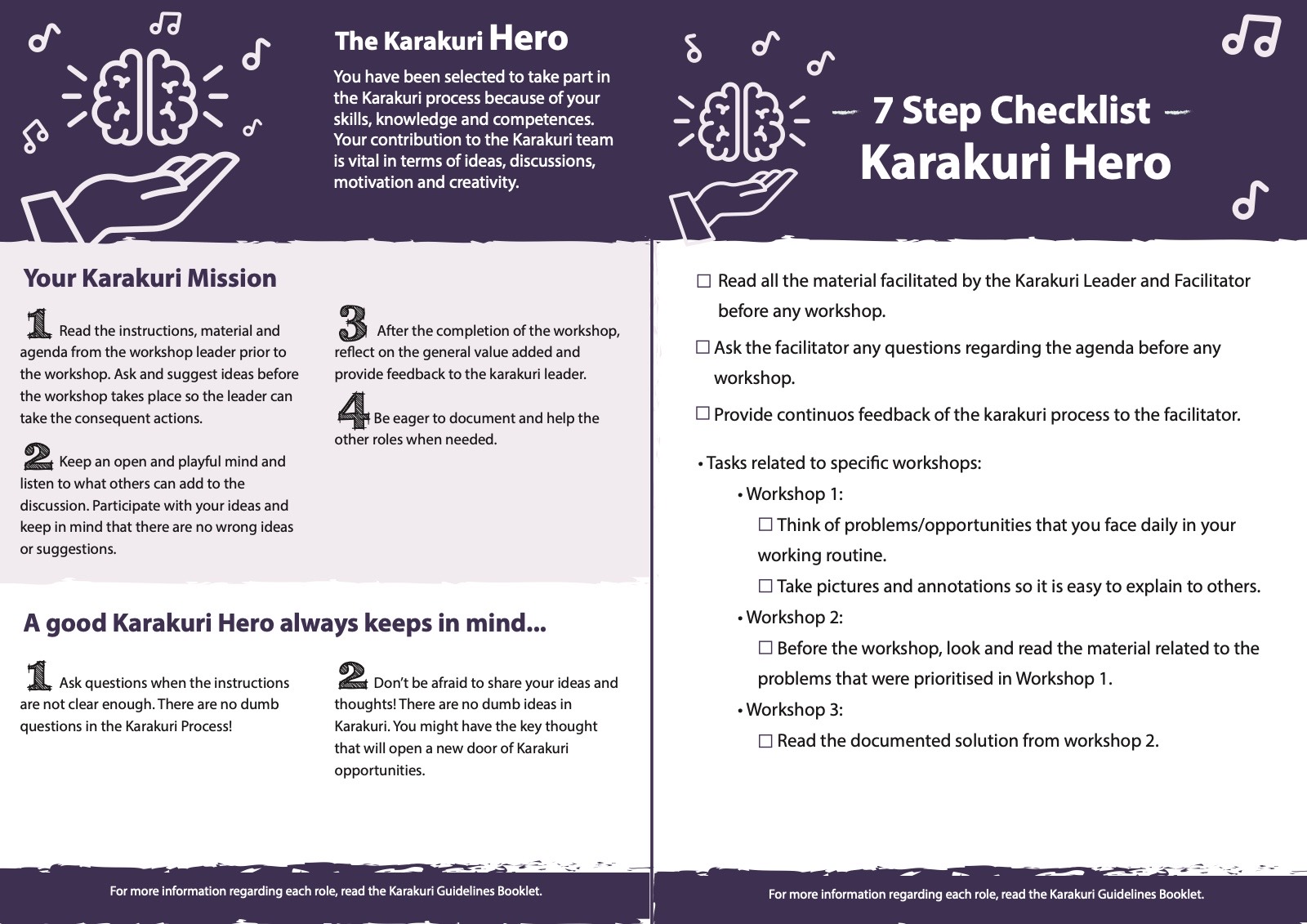
Paper roles helped too. Besides the facilitator and the leader, one participant could be the Documentator, who checks that every result can be understood later, and another the Tempo maestro, who keeps the time.
Hands on the table
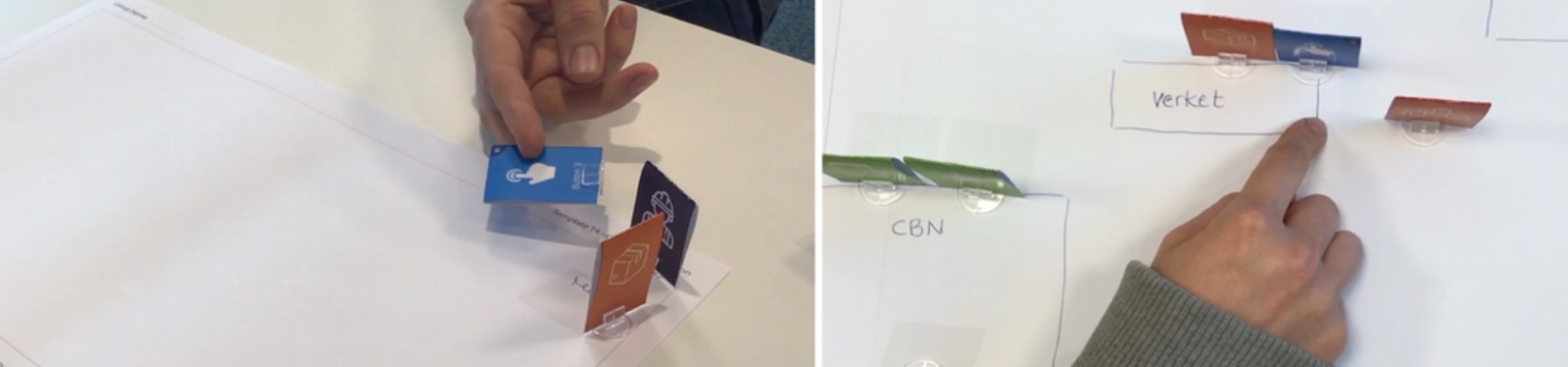
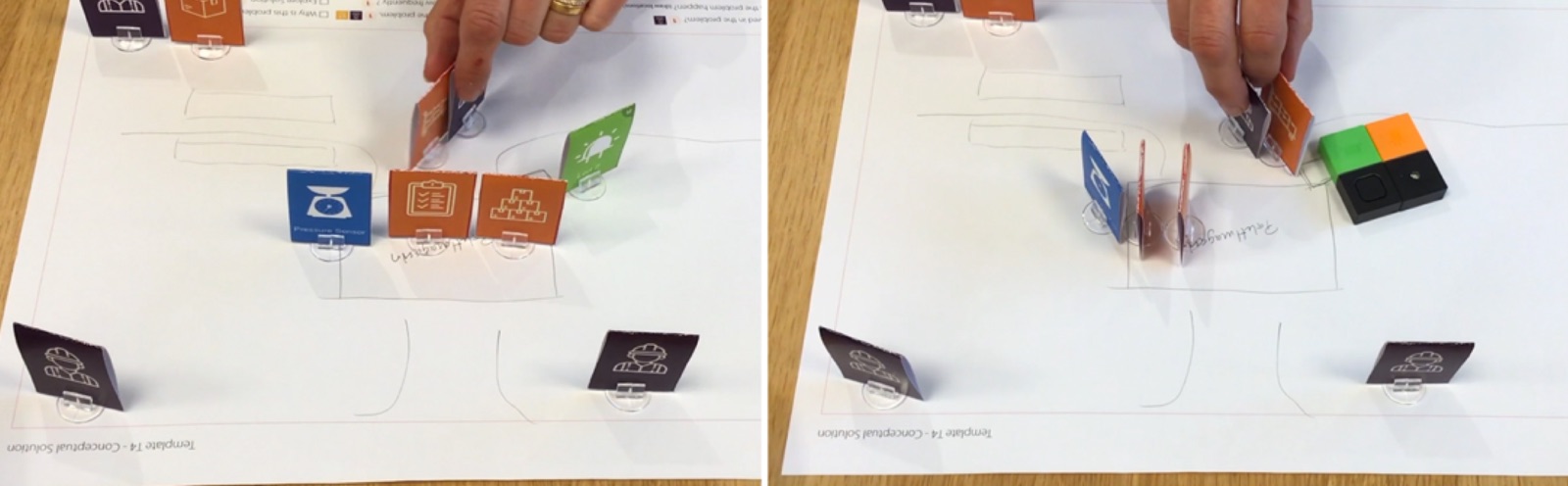
The best part was watching what people did with their hands. Tokens stand up by themselves, so hands are free. People hold two tokens in one hand, walk a worker token across the canvas to pick up a box, and put it down somewhere else.
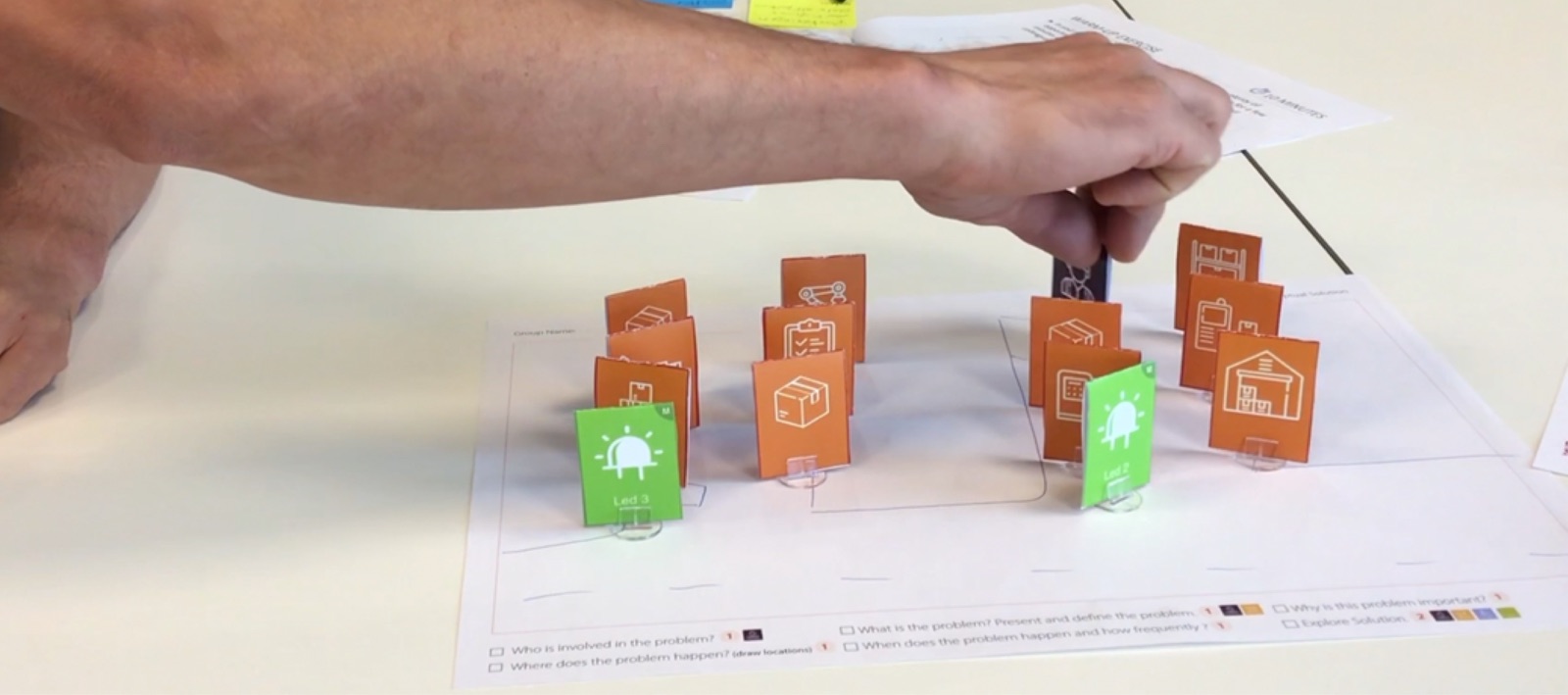
They press the button token to show when an alarm is sent. One participant showed a production stop by knocking two machine tokens over with a finger, one after the other. They were not even machine tokens, just orange ones. It didn’t matter.
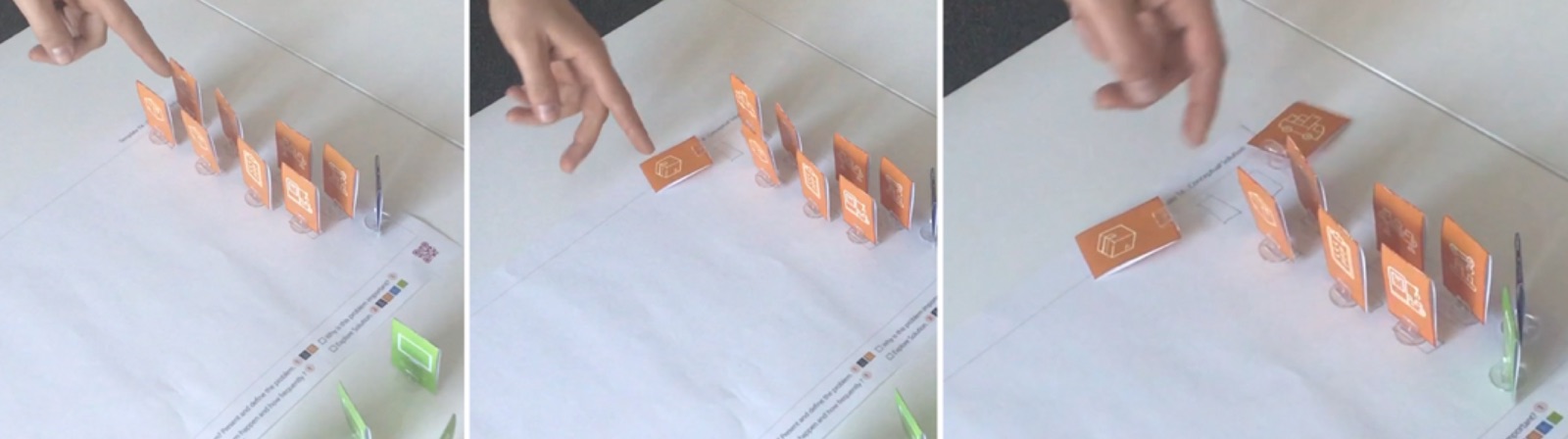
In the last step, the paper sensors become real. A worker token passes in front of a motion sensor, and the LED lights up.
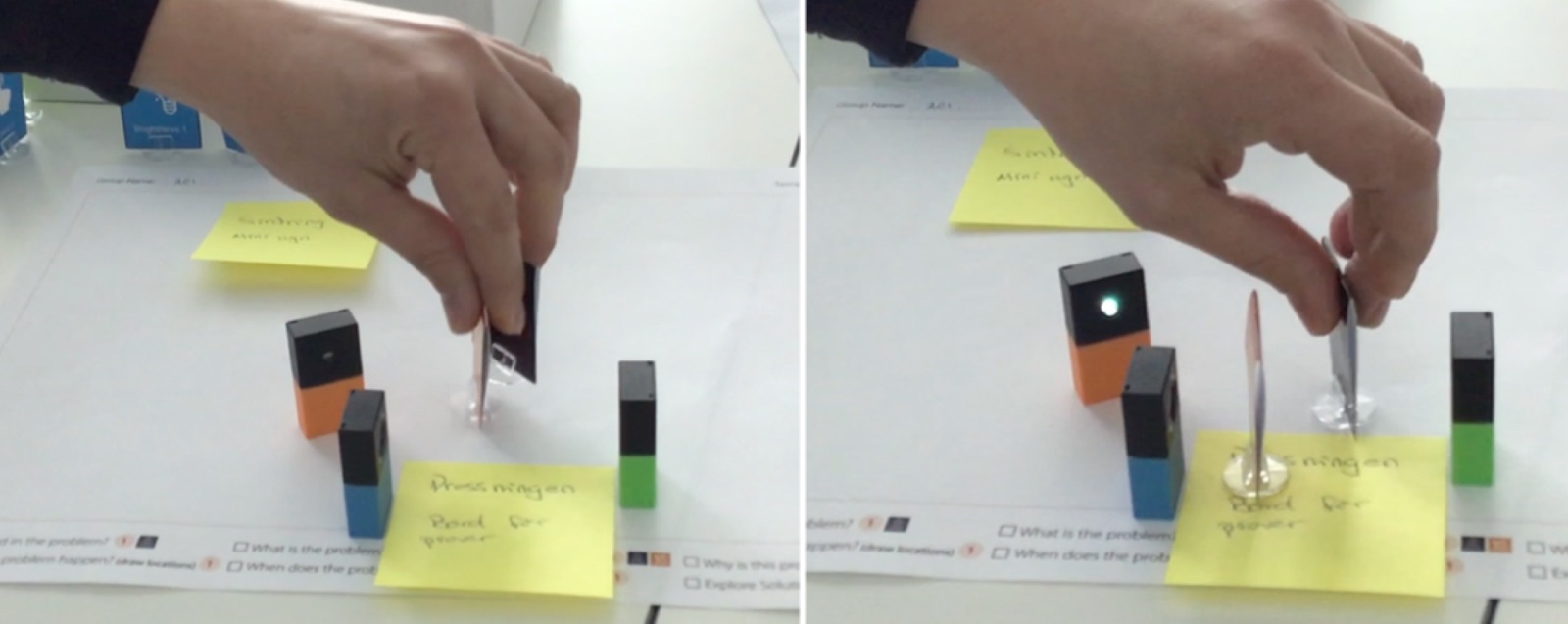
Not every paper sensor has a real twin. One participant wanted a pressure sensor, and there wasn’t one in the box. He used a button instead, and pressed it at the moment the pressure sensor would have triggered. The idea was still clear.
What came out of it
Every group in the workshops found a problem, explored it, and agreed on a solution they could present to the others. The ideas were down to earth: knowing where the empty carts are, telling everyone about a production stop as it happens, warning before packaging material or powder runs out, finding the right pallet.
Over the years, the different versions of Karakuri IoT reached more than two hundred people from more than thirty-five companies in Sweden.
Read more
- Yamamoto, Y., Aranda Muñoz, Á., & Sandström, K. (2026). Empowering factory employees through low-cost automation in IoT adoption. Journal of Industrial Engineering and Management, 19(2), 245–259.
- Aranda Muñoz, Á. (2024). Collaborative thinking with and through technology: Materials, methods and perspectives [Doctoral dissertation, Mälardalen University].
- Aranda-Muñoz, Á., Yamamoto, Y., & Sandström, K. (2024). The Karakuri IoT toolkit: A collaborative solution for ideating and prototyping IoT opportunities. Proceedings of the Design Society, 4, 185–194.
- Aranda Muñoz, Á., Eriksson, Y., Yamamoto, Y., Florin, U., & Sandström, K. (2021). To support IoT collaborative expressiveness on the shop floor. Proceedings of the Design Society, 1, 3149–3158.
- Aranda Muñoz, Á., Florin, U., Eriksson, Y., Yamamoto, Y., & Sandström, K. (2020). The Karakuri card deck: Co-designing industrial IoT conceptual solutions. Proceedings of the Design Society: DESIGN Conference, 1, 807–816.
- Yamamoto, Y., Sandström, K., & Aranda Muñoz, Á. (2018). Karakuri IoT: The concept and the result of pre-study. In P. Thorvald & K. Case (Eds.), Advances in manufacturing technology XXXII (pp. 311–316). IOS Press.
- Yamamoto, Y., Sandström, K., & Aranda Muñoz, Á. (2018). Development of methods that support exploration of simple and low-cost IoT-aided improvement solutions at manufacturing plants [Paper presentation]. 2018 Annual Autumn Meeting of the Japan Industrial Management Association, Tokyo, Japan.