Thinking with and through technology
My PhD ended in a framework: four steps for preparing workshops where people who are not experts in technology imagine how it could make their work better.

The question
IoT, AI and digital twins are arriving at workplaces faster than most people can learn about them. The people who know the work best, on a factory floor or in a hospital, are rarely the ones who get to imagine what these technologies should do there.
During my PhD I asked two questions. What do people need in order to imagine improvements to their own work with technology? And how can a designer use that to prepare the workshops where it happens?
Three cases
The answers came from three projects, each with its own materials and method:
- Karakuri IoT. Factory workers ideating, describing and prototyping improvements with sensors, using paper tokens and real sensors. I wrote about it in its own post.
- A digital twin. People in a manufacturing setting conceiving what a digital twin could do for them, before anyone built it.
- Co-experiential futuring. Workers, mostly from healthcare, imagining future roles, skills and products with IoT and AI, through speculative design and artistic methods.
The dimensions
Looking back at the three cases, I found a set of dimensions that a designer needs to keep in mind. They fall into three groups:
- Joint inquiry. How a group explores a problem together and turns it into an idea. This part builds on what participatory and interaction design already know.
- Technology. Demystifying what a technology can do; the framings and metaphors we use for it; its material properties, as something to touch and combine; and its responsible and sustainable use.
- Work. The organisation and its goals; documenting ideas so others can pick them up; spreading the work beyond the few who attend a workshop; and integrating the ideas safely into everyday work.
None of this is a checklist. The dimensions are there to inspire, guide and question the person who prepares the workshop.
The framework, in four steps
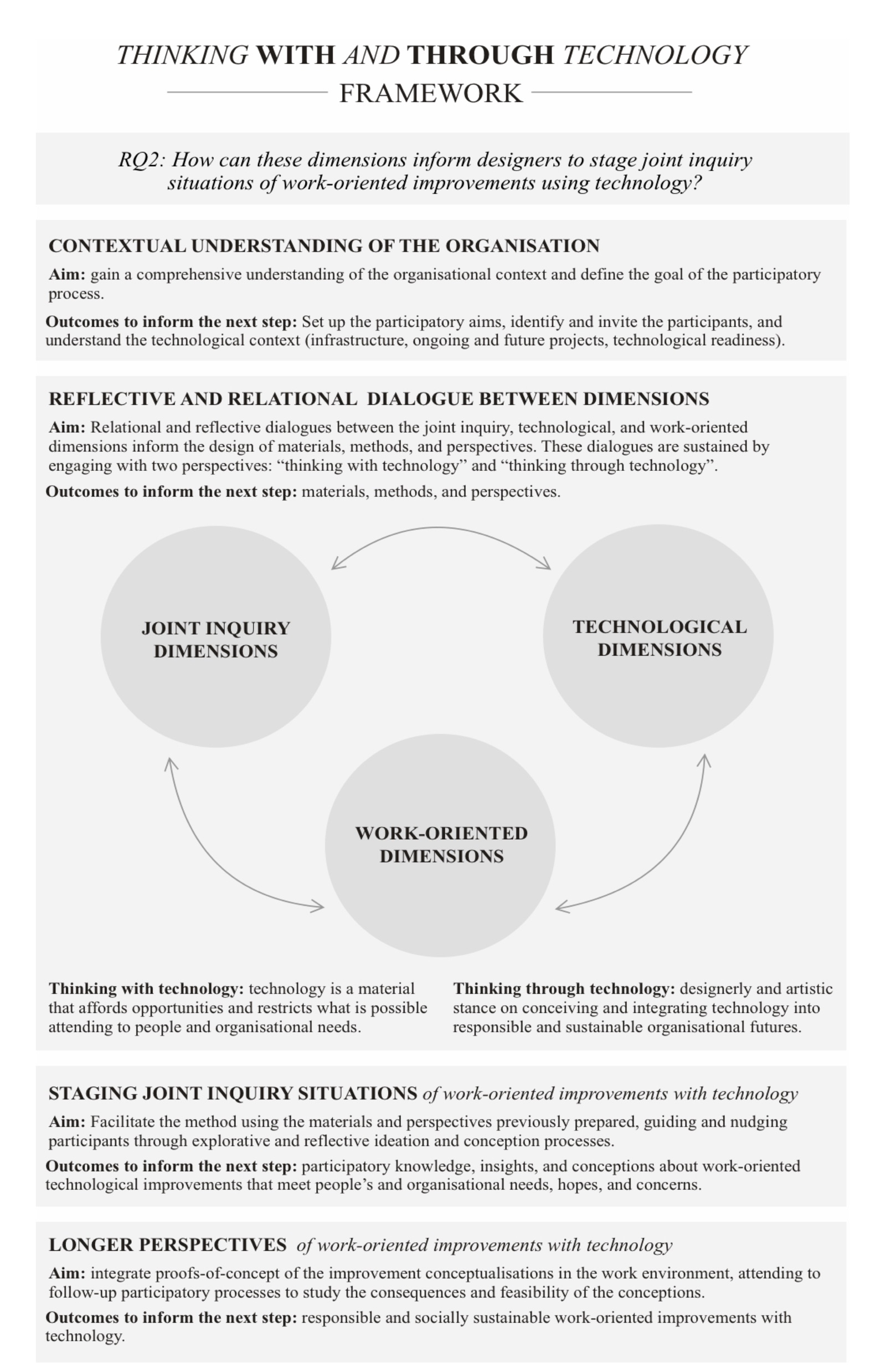
- Understand the organisation. Its culture, its technology, its plans and its problems. What do people there think about technology? What should the workshop produce?
- Hold a dialogue between the dimensions. Weigh each dimension against that context, and decide on the materials, the method and the perspectives to bring.
- Stage the workshop. Facilitate, nudge, leave room for reflection, and watch what happens, so the next version can be better.
- Take the longer view. Who builds the idea, who maintains it, how it fits the work and the systems already in place, and how to test it safely.
With, and through
The second step rests on two ways of looking at technology.
Thinking with technology treats it as a material. Like wood or paper, it offers some things and resists others. What can it sense? What is ready, and what is affordable? How do I show someone what a sensor does before asking them to imagine with it?
Thinking through technology takes a critical, designerly and artistic stance. What do we already believe about this technology? Which metaphors are we bringing into the room, and which ones are misleading? Artistic methods can stretch those perspectives, so people can question their values and the role they want technology to play at work.
Thinking only with technology makes it easy to build something nobody questioned. Thinking only through it makes it easy to imagine something nobody can build.
Who it is for
I wrote it for designers and researchers who invite people into the early stages of change at work. It can also help anyone who brings different people together to imagine solutions with technology, or who teaches these technologies inside organisations. The hope behind it is that people at work can voice their ideas, concerns and hopes about the technology that is arriving in their jobs.
Read more
- Aranda Muñoz, Á. (2024). Collaborative thinking with and through technology: Materials, methods and perspectives [Doctoral dissertation, Mälardalen University].